
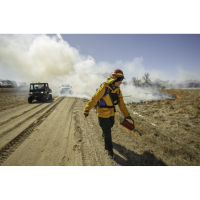
Prescribed burns this spring will play a critical role in protecting wildlife habitat and reducing wildfire risk at Sherburne National Wildlife Refuge. This year’s planned burn areas include the northeast area of the refuge around Blue Hill Trail and Refuge Headquarters.
Prescribed burns are one of the most effective tools for managing fire-adapted ecosystems such as native prairie and oak savanna. Oak savanna is fire-dependent, meaning many of the native species growing there require fire to thrive and are naturally protected from fire damage. Mature oaks, for example, have thick, corky bark that shields them from fire damage. While fast-growing birch and willow trees, that can shade out young oak saplings, lack this protection, giving oaks an advantage after fire.
Prescribed burns also help reduce the risk of wildfires. By removing excess vegetation under controlled conditions, prescribed burns lower wildfire intensity, thereby reducing risk to nearby private properties, wildlife habitat, wildland firefighters and the local community.
Each burn is conducted under strict guidelines for weather and safety called a "prescription," which includes temperature, wind speed and direction, relative humidity and fuel conditions. These prescriptions are designed to meet specific vegetation and wildlife management objectives. Before ignition, staff also evaluate smoke drift, nearby structures, livestock and other safety considerations. Burns proceed only if the prescription and other safety factors meet all requirements of the approved burn plan.
The refuge averages around 4,000 acres of prescribed burning each year. While the refuge conducts prescribed burns annually, individual areas are not burned every year. Historically, oak savannas and prairies in this region burned every three to ten years due to natural or human-caused fires, and the refuge works to replicate that pattern to support ecosystem health.
After a burn, visitors may see smoldering logs which are a part of the prescribed burn process. These areas are closely monitored by refuge staff who ask that visitors stay on roads and trails for their safety. Any alerts about temporary trail closures will be available on the refuge website, www.fws.gov/refuge/sherburne/, or can be obtained by calling Refuge Headquarters at 763-389-3323.
Sherburne National Wildlife Refuge is managed by the U.S. Fish & Wildlife Service, and is located near the cities of Princeton, Zimmerman, and St. Cloud, in central Minnesota. For more information, visit www.fws.gov/refuge/sherburne/ or contact us at sherburne@fws.gov or 763-389-3323.
The U.S. Fish and Wildlife Service works with others to conserve, protect, and enhance fish, wildlife, plants, and their habitats for the continuing benefit of the American people. For more information, visit www.fws.gov and connect with us on social media: Facebook, Instagram, X (formerly known as Twitter), LinkedIn, Flickr, and YouTube.
-
Jared Culbertson
- April 06, 2026
- 320-693-2849
- Send Email
